What is brand protection?
What is brand protection? Learn the meaning, key risks, and how modern brand protection helps prevent fraud, impersonation, and digital threats.
In this article
In November 2022, a fake account impersonating Eli Lilly, made to look official with a paid blue tick, posted that insulin was now free. The next day its shares fell, an estimated $15 billion was wiped from the company's market value, and Eli Lilly paused its advertising on the platform. One unverified post, taken for genuine, reached the company's valuation in hours.
That is the reality brand protection now exists to manage. A brand is no longer defended only at the trademark registry or the warehouse door. It is defended across social platforms, search, marketplaces and domains, where a convincing fake moves faster than any internal approval process. For enterprise marketers and brand managers, brand protection has become an operational function, not a legal afterthought.
What is brand protection?
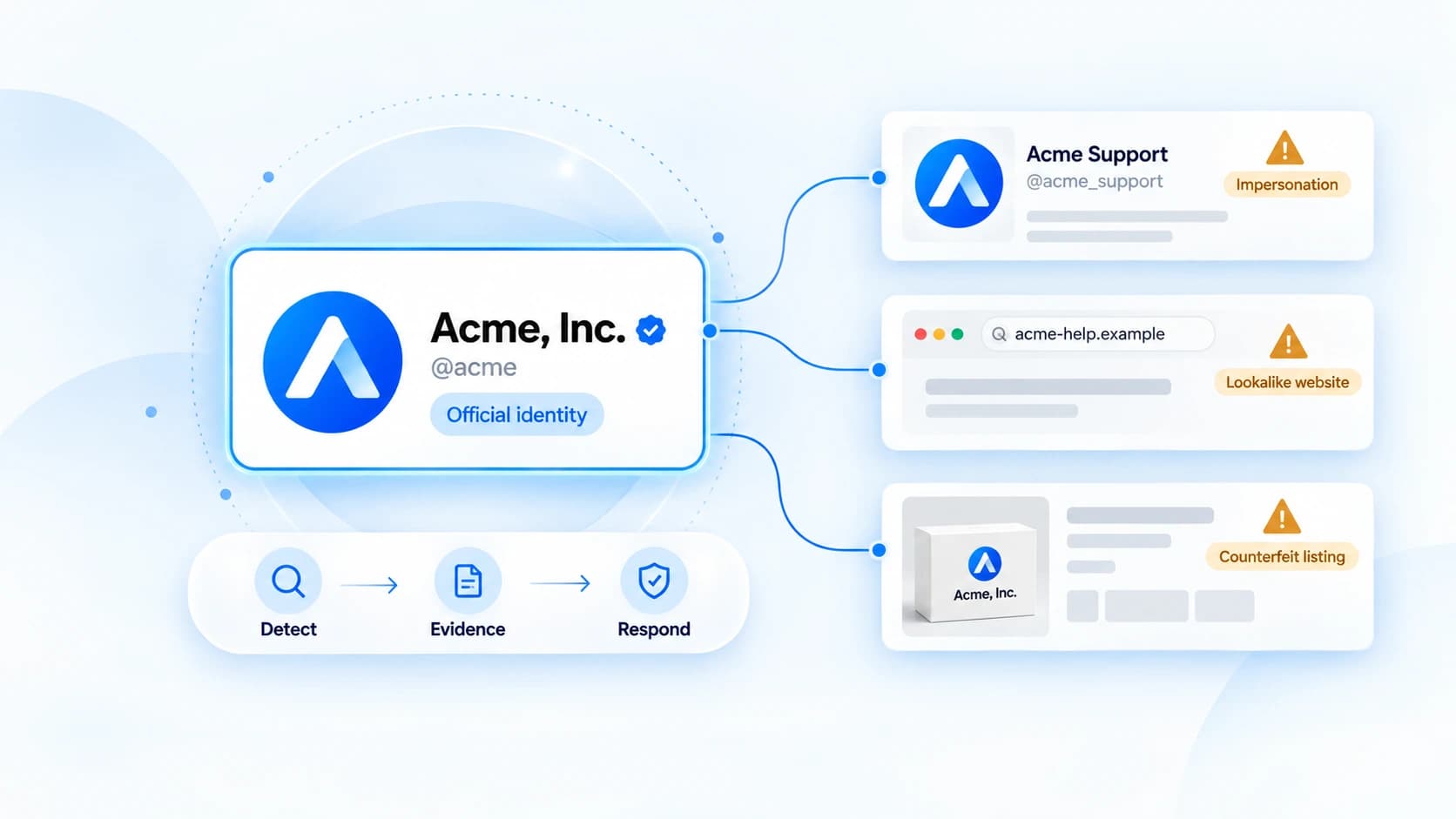
Brand protection is the practice of monitoring, detecting and preventing the misuse of a brand across digital and physical channels. It covers counterfeit goods, fake social accounts, spoofed domains and fraudulent ads that borrow a brand's name, logo and identity to deceive customers.
The discipline has widened. Traditional brand protection began with trademark enforcement: registering marks and pursuing infringers through legal channels. Online brand protection, sometimes called digital brand protection, now extends that work to the places where customers actually form judgements, which are social feeds, search results and app stores. The object being protected is the same, brand trust and the revenue it underpins. What has changed is the size of the risk surface.
Why brand protection matters
The scale is no longer marginal. According to the Federal Trade Commission, US consumers reported losing $2.1 billion to scams that started on social media in 2025, around eight times the 2020 figure and the costliest contact method of the year. Separately, imposter scams, in which fraudsters pose as trusted businesses and agencies, were the most reported fraud category, at $3.5 billion in reported losses. Much of that fraud wears a real brand's identity, and it has grown because the tools to imitate a brand are cheap and AI has made fakes more convincing. Impersonation and fake accounts now scale at the speed of a paid campaign.
The cost lands on the brand, not only the victim. Customers deceived by a fake account or spoofed site tend to blame the brand rather than the fraudster, which erodes trust, drives churn and raises the cost of every future marketing effort. For enterprises operating across dozens of markets and platforms, each new channel adds exposure that has to be governed.
Regulation is tightening too. Consumer-protection and platform-accountability rules increasingly expect brands to act on impersonation that uses their identity, making a documented response a compliance matter as well as a commercial one.
The main brand protection threats
Most online brand abuse falls into a handful of recurring types:
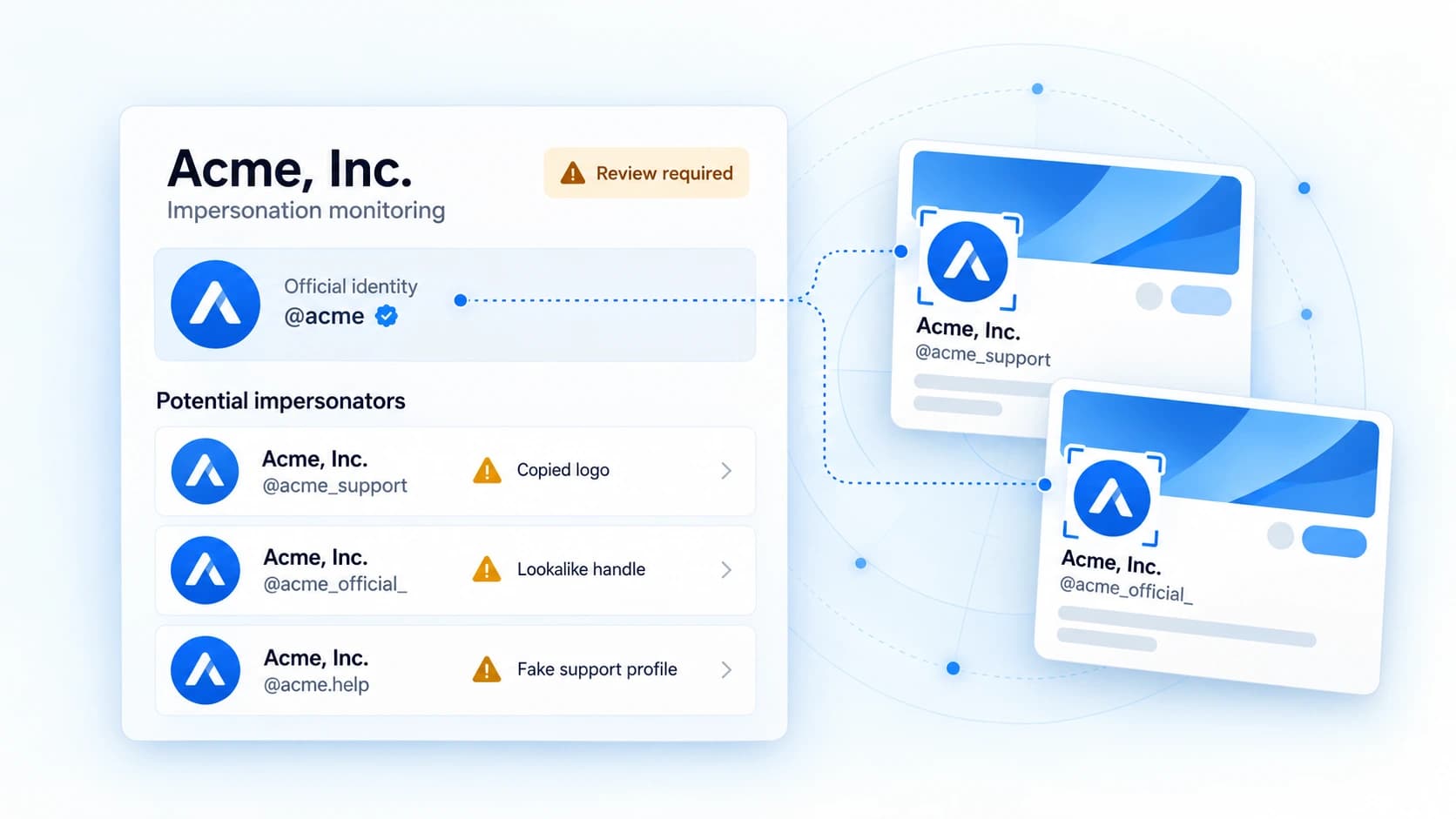
- Social media impersonation. Fake accounts copy a brand's name, handle, logo and bio to deceive followers, run scams or damage reputation. This is distinct from fan accounts or legacy profiles, and not every unofficial account is malicious.
- Phishing and fraud campaigns. Scammers use a brand's identity in emails, ads and messages to harvest credentials or payments.
- Counterfeit products and marketplace abuse. Fake goods and unauthorised sellers trade on a brand's name across online marketplaces.
- Domain and website abuse. Cybersquatting and lookalike domains host spoofed sites that intercept traffic and sales.
- Fake reviews and reputation manipulation. Fabricated reviews and coordinated posts distort the trust signals customers rely on.
What does brand protection include?
A modern brand protection strategy combines four capabilities. Monitoring and detection track brand mentions, accounts, domains and listings across channels to surface threats early. Enforcement and takedowns remove harmful content, accounts and listings through the relevant platform or legal process, where policy allows. Threat intelligence and analysis turn individual incidents into patterns, identifying repeat offenders and emerging tactics. Automation and technology, including AI, let teams scale this work across a volume of content no manual team could review.
How brand protection works in practice
At enterprise scale, brand protection runs as a continuous workflow rather than a one-off project. Teams monitor platforms continuously, identify and prioritise threats by their potential to move money or damage trust, take enforcement action through takedowns and reports, then measure and optimise the programme over time. The aim is a repeatable remediation workflow, not a reactive scramble after each incident. Better evidence shortens that loop: a clear evidence pack creates a clearer route to remediation when a case reaches a platform's review team.
Brand protection vs related concepts
Brand protection is often confused with adjacent disciplines. The distinction is its proactive, prevention-led focus.
| Discipline | Focus |
|---|---|
| Brand protection | Preventing and remediating misuse of a brand's identity, such as impersonation, counterfeits and fraud |
| Reputation management | Shaping public perception and responding to sentiment and reviews |
| Brand monitoring | Tracking mentions and visibility, often for marketing insight rather than enforcement |
| Cybersecurity | Defending systems, networks and data from intrusion |
Brand monitoring tells you what is being said. Brand protection acts on what is being misused.
Brand protection tools, technology and services
Effective brand protection solutions usually combine tools, technology and managed expertise.
Brand protection tools provide the monitoring and detection layer. For the social dimension specifically, handles.ai gives brand teams a control layer for social identity: Radar monitors platforms for impersonation and infringement, Pulse audits a brand's social presence, Governance standardises naming conventions and access controls, and IP Claims supports trademark enforcement and takedown management. The platform reports scanning more than 2.5 million harmful brand variants across leading brands.
Brand protection technology is what makes this work at scale. AI, automation and machine learning classify accounts, flag likely impersonation and prioritise cases, so analysts can focus on the threats that matter.
Brand protection services add human judgement. Managed services combine the technology with experts who handle evidence, escalation and negotiation, including routes such as Handle Acquisition, where securing an official handle is a better outcome than enforcement.
Best practices for effective brand protection
A few practices separate a controlled programme from a reactive one: secure your digital assets and official accounts, run a regular social media security audit to establish a source of truth for what is genuinely yours, monitor continuously across channels, respond quickly with a documented evidence pack, educate internal teams and customers on what your official presence looks like, and use dedicated tools and services rather than relying on manual checks.
Future trends in brand protection
The direction of travel is clear. AI-driven threats, including deepfakes and AI-generated personas, will keep lowering the cost of convincing fakes. Platforms face growing pressure to take more responsibility for the fraud they host. Identity verification and trust signals are becoming central to how customers and platforms tell real from fake. And brand protection is shifting from periodic clean-ups to proactive, real-time governance.
Conclusion
Brand protection is no longer optional. As impersonation, fraud and AI-generated abuse scale across digital channels, protecting a brand's revenue, trust and digital identity has become a core enterprise function. handles.ai helps brands govern, secure and optimise their social media presence by creating a clear source of truth for official accounts, handle ownership, impersonation risk and platform remediation, the control layer a modern brand protection strategy depends on.
FAQs
What is brand protection?
Brand protection is the practice of monitoring, detecting and preventing misuse of a brand across digital and physical channels, including impersonation, counterfeits, phishing and fraud.
What does brand protection mean in marketing?
In marketing, brand protection means safeguarding the brand value and reputation that drive customer trust and revenue, so the identity teams build is not exploited by fraudsters or diluted by fakes.
What are the most common brand protection threats?
The most common threats are social media impersonation, phishing and fraud campaigns, counterfeit products and marketplace abuse, domain and website abuse, and fake reviews.
How does brand protection work?
It works as a continuous cycle of monitoring channels, detecting and prioritising threats, enforcing through takedowns and reports where policy allows, and optimising the programme over time.
Do I need brand protection tools or services?
If your brand operates across multiple platforms and markets, manual checks rarely keep pace. Dedicated tools and managed services help identify and remediate abuse at a scale internal teams cannot match alone.
Check the research and platform guidance behind claims used across the site in our sources & references .
Continue reading
All articles
Social Media Brand Protection: The Complete Guide
Protect your brand's social presence with this complete guide to social media brand protection. Learn key threats and strategies for online brand protection.
What Is Brand Monitoring? Definition, Uses & How It Works
What is brand monitoring? Learn what brand monitoring means, how it works, and how it supports visibility, risk detection, and online brand protection.
What is social media brand protection? Definition, risks and how it works
What is social media brand protection? Learn how to detect fake accounts, prevent impersonation, and protect your brand across social platforms.